Is the Military Base Opening Again in Iceland
| Naval Air Station Keflavik | |||||||||||||||
|---|---|---|---|---|---|---|---|---|---|---|---|---|---|---|---|
| Near Reykjanesbær, Southern Peninsula in Republic of iceland | |||||||||||||||
 Three US Navy P-8A Poseidon maritime patrol shipping parked on the apron of NAS Keflavik during Nov 2019 | |||||||||||||||
| NAS Keflavik Location in Iceland | |||||||||||||||
| Coordinates | 63°59′06″North 22°36′twenty″West / 63.98500°Due north 22.60556°W / 63.98500; -22.60556 Coordinates: 63°59′06″N 22°36′20″W / 63.98500°N 22.60556°W / 63.98500; -22.60556 | ||||||||||||||
| Blazon | Naval Air Station | ||||||||||||||
| Site information | |||||||||||||||
| Owner | Icelandic Government | ||||||||||||||
| Operator | United states of america Navy | ||||||||||||||
| Controlled past | Navy Region Europe, Africa, Fundamental | ||||||||||||||
| Status | Operational | ||||||||||||||
| Site history | |||||||||||||||
| Built | 1951 (1951) | ||||||||||||||
| In use |
| ||||||||||||||
| Airfield information | |||||||||||||||
| Identifiers | IATA: KEF, ICAO: BIKF, WMO: 040180 | ||||||||||||||
| Acme | 51.5 metres (169 ft) AMSL | ||||||||||||||
| |||||||||||||||
| Airfield shared with Keflavík International Airport Source: Iceland Aeronautical Information Publication[i] | |||||||||||||||


Naval Air Station Keflavik (NASKEF) was a U.S. Navy station at Keflavík International Aerodrome, Iceland, located on the Reykjanes peninsula on the s-westward portion of the island. NASKEF was airtight on viii September 2006, and its facilities were taken over past the Icelandic Defense Agency every bit their principal base of operations until i Jan 2011, when the Agency was abolished and the base handed over to the Icelandic Coast Guard, which has since then operated the base.[ii]
The base was built during World War Ii by the United States Army equally function of its mission to maintain the defence of Iceland and secure northern Atlantic air routes. It served to ferry personnel, equipment, and supplies to Europe. Intended equally a temporary wartime base under an agreement with Iceland and the British, United states of america forces withdrew past 1947 but returned in 1951 equally the Iceland Defense resident on a North Atlantic Treaty Organization (NATO) base. The base was regularly visited by the American military and other NATO allies for war machine exercises, NATO Air Policing, and other tasks. In 2017, the The states announced its intention to change the largest hangar on the Icelandic base in order to house the new Boeing P-8 Poseidon ASW aircraft existence introduced.[3]
History [edit]
Groundwork [edit]

Keepsake of the Icelandic Base Control

Lockheed P-38F-v-LO Lightning 42-12596 of the 50th Fighter Squadron in Republic of iceland, 1942
After being granted self-governance by Denmark in 1918 with the signing of the 25-year Danish-Icelandic Act of Spousal relationship, Iceland followed a policy of strict neutrality in international affairs. In 1939, with war imminent in Europe, the High german Reich pressed for landing rights for Lufthansa'due south shipping for alleged trans-Atlantic flights. The Icelandic regime turned them down.[ commendation needed ]
A British request to found bases in Republic of iceland for the protection of the vital North Atlantic supply lines after German forces occupied Kingdom of denmark and Norway in April 1940 was also turned down in accordance with the neutrality policy. In response, on 10 May 1940 the people of Reykjavík awoke to the sight of a British invasion strength. The government of Republic of iceland protested the invasion but asked the populace to care for the occupying force as guests.
Following talks between British Prime number Minister Winston Churchill and President Franklin D. Roosevelt of the U.s., Republic of iceland agreed to a tripartite treaty under which Usa Marines were to relieve the British garrison in Iceland on the condition that all military forces exist withdrawn from Republic of iceland immediately upon the determination of the war in Europe. In addition to their defense force role, U.S. forces constructed the Keflavik Airdrome as a refueling point for aircraft deliveries and cargo flights to Europe[ citation needed ].
2nd Earth War era (1940s) [edit]
The airport was built by the United States military during World State of war II, as a replacement for a small British landing strip at Garður to the due north. It consisted of two separate two-rails airfields, built simultaneously just iv km apart. Patterson Field in the southward-eastward opened in 1942 despite being partly incomplete. It was named after a young pilot who died in Iceland. Meeks Field to the north-west opened on 23 March 1943. It was named after some other immature pilot, George Meeks, who died on the Reykjavík airfield. Patterson Field was closed after the war, just Meeks Field and the adjoining structures were returned to Iceland's command and renamed Naval Air Station Keflavik after the nearby boondocks of Keflavík. In 1951, the U.Due south. armed forces returned to the airport under a defence understanding between Republic of iceland and the U.Southward. signed on 5 May 1951.[iv]
With the cease of the war in Europe, Keflavik Airdrome became a transit point for aircraft returning from the European Theater of Operations to the U.s.a.. With American air activities profoundly reduced in Europe in the immediate postwar months, U.S. flying operations were similarly reduced in preparation for transfer of the base to the Icelandic government at the cease of 1946. With all noncritical surplus equipment and supplies tending of, all U.South. air activity concluded at the airfield on 11 March 1947.
Military Air Transport Service era (1951–1961) [edit]


Due north American F-51D Mustangs of the 192d Fighter-Bomber Squadron (Nevada Air National Guard) stationed at Keflavik 1952-1953


57th Fighter Interceptor Squadron F-102s at Keflavik Airport, 1973

57th Fighter Interceptor Squadron (The Black Knights) Patch

A 57th FIS F-4C with a Soviet Tu-95 Bear in 1973.
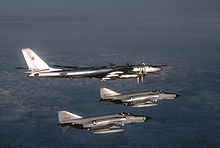
57th FIS F-4Es intercepting a Soviet Tu-95 Bear D in 1980.

F-15C-28-MC Eagle (due south/northward fourscore-0035) of the 57th Fighter Interceptor Squadron, 1986
Another agreement signed betwixt the United States and Republic of iceland in 1946 permitted continued utilize of the base by the United States. The United States provided all the maintenance and functioning of the aerodrome through an American civilian contractor. American Overseas Airlines, followed by Airport Overseas Corporation personnel, operated the military machine portion of Keflavik Airport later on its reversion to Icelandic control at the end of March 1947.
In 1949, Iceland voted to join the North Atlantic Treaty Organization (NATO) amongst protests about the The states militarizing the country, and the base assumed the status of significant strategic importance in the Cold State of war. Though reluctant to sanction the stationing of strange troops in significant numbers on their soil, Icelandic officials decided in calorie-free of the fact they had no standing army to speak of, that membership in NATO alone was not a sufficient defense; and at the asking of NATO, Iceland entered into a defence force agreement with the United States direct[ commendation needed ]. This was the beginning of the Republic of iceland Defense Force. Over the side by side 4 decades, the Defense force Forcefulness was "at the front" of the Common cold War and was credited[ past whom? ] with playing a meaning function in deterrence.[ citation needed ]
On 25 May 1951 the U.S. Air Strength reestablished its presence at Keflavik Airdrome with the stationing of the 1400th Air Base Group. Jurisdiction of the airport was assumed by Military Air Ship Service (MATS). MATS re-established a armed services air concluding and refueling point for trans-Atlantic air service between the United States and Europe at Keflavik. MATS (later MAC and Air Mobility Control) units remained at the airport until the withdrawal of United States military units from Iceland in 2006.
During 1947–51, while the base was operated past a Us noncombatant contractor company most of the World War 2 temporary structures were left empty and became badly deteriorated. The airfield complex, one of the largest in the globe during the war, also required upgrading to accommodate modern shipping. The contractor had extended one runway, constructed a new passenger last and hotel building, one aircraft hangar, a hospital, housing units and other facilities for the staff. But this was insufficient for the new Defence Force, so additional facilities had to be provided quickly. A crash reconstruction plan was initiated and temporary housing was erected during the construction of permanent housing. The airfield was extended by the Nello L. Teer Company[5] and two new aircraft hangars were constructed. Most of this work was completed past 1957.
Presently afterward the return of US forces to Keflavik. Air Defense Command (ADC) established a temporary radar station at the airport, equipped with Globe War 2-era AN/TPS-1 and AN/TPS-3A radars that operated until a permanent radar station could be constructed at nearby Rockville AS.[ citation needed ]
Between 1952 and 2006, Air Forces Republic of iceland provided air defense for Iceland, operated Keflavik Airport, and furnished base back up for all U.Southward. military forces in Iceland participating in its defense under NATO. Also Air Force component of NATO Iceland Defense.
ADC, subsequently renamed Aerospace Defense Command used the facility for air surveillance of Iceland and the North Atlantic, employing F-102 Delta Dagger and and then F-4C Phantom Two fighters as interceptors. Over 1,000 intercepts of Soviet aircraft took identify inside Iceland's War machine Air Defence force Identification Zone (ADIZ).[ citation needed ]
[edit]
The United States Navy assumed the responsibility of running the air station from MATS in 1961.[ citation needed ]
In 1974, the left-wing Government of Iceland'due south new proposal to close the base triggered a petition that garnered 55,000 signatures, well-nigh a quarter of the population of the entire nation. This led to the ruling coalition collapsing and the 1974 Icelandic parliamentary ballot being held.[6]
On ane October 1979 Tactical Air Command (TAC) absorbed ADC'southward assets, and the F-4E Phantom II aircraft of the 57th Fighter Interceptor Squadron (57 FIS). In July 1985, F-15Cs and F-15Ds replaced the aging F-4s, and the tail lawmaking "IS" was assigned to Air Forces Iceland (AFI).[ citation needed ]
During the meridian of the Common cold War in the 1980s, Keflavik also hosted rotational E-3 Lookout AWACS aircraft and KC-135 Stratotanker shipping from CONUS to support the air defence force mission and rotational HC-130 Hercules aircraft from RAF Woodbridge from the 67th Aerospace Rescue and Recovery Squadron to back up their detachment of Keflavik-based HH-3 Jolly Green Giant and later HH-60G Pave Hawk helicopters in their search and rescue mission.
Outset in 1984, the 932d Air Command Squadron established a Radar Operations Control Center at Keflavik which coordinated the 57th FIS interceptors to contacts passing through the GIUK gap. Information technology received long-range radar inputs from 5 radar sites: the four sites in Republic of iceland plus a data-tie from the Thorshavn AS radar in the Faroe Islands. Thorshavn was located atop Mountain Sornfelli. The ROCC remained agile until the turnover of the facility in 2006.
Air Forces Iceland continued the air defense mission of Republic of iceland as a tenant organization at Keflavik. Under ADC until 1979 and under TAC until 1992. On 1 June 1992, Air Combat Command (ACC) assumed command and control of AFI and the 57 FIS. Less than a twelvemonth after, the 57 FIS was redesignated every bit the 57 Fighter Squadron (57 FS) and reassigned to the 35th Fighter Fly that was transferred from the endmost George AFB, California.[ citation needed ]
On i October 1994, the 35th Fly was inactivated at Keflavik and reactivated that same day at Misawa Air Base of operations in Misawa, Nippon. The 35th Wing was replaced past the newly activated 85th Fly. On ane March 1995, the 57th FS was inactivated and the interceptor forcefulness was replaced past Regular Air Force and Air National Baby-sit F-xv Eagle fighter aircraft rotating every ninety days to Republic of iceland until the USAF inactivated the 85th Group in 2002. United states of america Air Forces in Europe (USAFE) took over ACC responsibilities at Keflavik on 1 October 2002 every bit function of a larger restructuring of the unified commands.
The 85th was reduced to a Group level and supported rotational deployments. The 85th Grouping continued to support rotational deployments until it was inactivated during a ceremony on 28 June 2006, as a effect of the Air Force reduction in forces in Iceland. All rotational fighters left and the 56th Rescue Squadron ceased operation at the end of the fiscal yr.[ citation needed ]
Deactivation and mail-military machine use (2006–2015) [edit]
On 15 March 2006, the U.S. Ambassador to Iceland announced that the Us had decided to substantially reduce the size of the Iceland Defense force Force.
During a six-month transition to reduce the military presence in Iceland, virtually facilities closed and nearly of the service members departed, leaving behind a core team of active duty and Reserve personnel to end the job.
By mid-July 2006, many of the military spouses and military active duty staff had transferred.
On eight September 2006, NASKEF'south final commanding officeholder, Capt. Mark S. Laughton, presided over a ceremony effecting the disestablishment of the air station.[vii] [8]
On 26 October the government of Republic of iceland established the Keflavik Airport Development Corporation or Kadeco which was given the task of converting those portions of the base of operations no longer needed into civilian employ.

Since May 2008 Keflavik has periodically hosted NATO fighter, AWACS and back up aircraft participating in Icelandic Air Policing deployments.[ix] [ten]
In January 2010, Verne Holdings appear that it had received equity funding from the Wellcome Trust to build a data center at Keflavik. The information center will take advantage of the available geothermal power and complimentary cooling to minimize its carbon footprint.[11]
Reactivation (2015 – present) [edit]
In September 2015, news media reported U.S. government officials expressed a desire to reopen aspects of the NATO base of Keflavik Naval Air Station, to cope with increasing Russian military activity around Iceland.[12] [13]
In 2016 the United States began preparations to establish regular patrol rotations at the base of operations,[14] and in 2017 announced its intention to build new hangars to house Navy P-viii Poseidon aircraft.[3]
Station names [edit]
- Reykjavik Administrative Surface area, 6 August 1941
- Meeks Field, one July 1942
- Keflavik Airport*, 25 October 1946 – 28 June 2006
- Under United States Navy Jurisdiction, one July 1961 – 28 June 2006
.* Usa Air Forces units changed from host to tenant status on 1 July 1961, when the U.S. Navy gained jurisdiction; the installation was renamed U.Southward. Naval Station Keflavik; Keflavik Airdrome became one of its tenants.
Major USAF Commands [edit]
- Iceland Base of operations Control, United states of america Army, February 1942
- European Theater of Operations, U.s. Army (ETOUSA), ten June 1942
- Eastern Defense Command, United States Army, thirty July 1944
- Air Transport Control, i Jan 1946 – 7 April 1947
Returned to control of Icelandic Government on 7 April 1947; returned to articulation Icelandic-USAF control, 23 May 1951.
- Articulation Task Force No. 109, 7 May 1951
- Iceland Defense Force, vi July 1951
- Military Air Transport Service*, one September 1951
- Air Defense Control, 1 July 1962
- Re-designated Aerospace Defense Control, 15 January 1968
- Tactical Air Command, 1 October 1979
- Air Combat Command, 1 June 1992
- United States Air Forces in Europe, ane Oct 1992 – 28 June 2006
.*Later 1 July 1961, the USAF MAJCOMs operated in a tenant status just.
Major USAF units assigned [edit]
|
|
.* Rotational TDY flights of aircraft from various squadrons of 52d Operations Group, Spangdahlem AB, Federal republic of germany
.** Rotational TDY flights of aircraft from 48th Operations Grouping, RAF Lakenheath, United kingdom of great britain and northern ireland
Operations [edit]
Naval Air Station Keflavik was the host command for all U.S. defense force activities in Republic of iceland. The major commands stationed on the base were the USAF'southward 85th Group, Armada Air Keflavik, the headquarters of the U.Southward.-provided Iceland Defence force, Naval Computer and Telecommunications Station (NCTS) Keflavik, U.S. Naval Hospital Keflavik and the Sound Surveillance System (SOSUS) shore last at Naval Facility (NAVFAC) Keflavik. The positions of Commander, Armada Air Keflavik and Commander, Iceland Defense Force were held by the aforementioned U.S. Navy rear admiral. At that place were more 25 different commands of various sizes and personnel from the United states Regular army, U.South. Navy, U.S. Air Force, U.South. Marine Corps, and U.Southward. Coast Guard in Iceland. Also present were representatives from Canada, the netherlands, Kingdom of norway, and Kingdom of denmark.
NASKEF was responsible for providing all support facilities, including the runways, housing, supply and recreational facilities. The primary mission of Naval Air Station Keflavik was to maintain and operate facilities and provide services and fabric to support operations of aviation activities and units of the operating forces of the Navy and other activities and units, as designated by the Principal of Naval Operations.

A U.S. Navy P-3C Orion of Patrol Squadron 56 (VP-56) at Keflavik, 1977.
U.Due south. Navy employ of the facility immune the housing of rotational P-3 Orion squadrons, shipping, flying crews, maintenance and administrative support personnel from their CONUS home bases for half-dozen-month deployments in support of antisubmarine warfare and maritime patrol missions until 2004. As a NATO mission, the U.South. Navy P-3s were oftentimes augmented past U.Due south. Navy Reserve P-3 squadrons and detachments of Canadian Forces CP-140 Aurora, Royal Netherlands Navy P-iii, German language Navy Breguet Atlantique and Regal Air Force Bell-ringer Siddeley Nimrod MR2 maritime patrol aircraft.
Army National Guard units and Acting Marine Security Forces stormed the lava fields surrounding the base of operations during preparation exercises such as Northern Viking.
NAS Keflavik employed approximately 900 Icelandic civilians who worked with war machine personnel, providing the services necessary to operate the base. Twenty-four hours a 24-hour interval, seven days a week, the airfield was available for maritime patrol activities, air defense and for transiting shipping betwixt North America and Europe, in addition to supporting Iceland's international civilian aviation.

The flag of Iceland existence raised and the flag of the The states being lowered as the Usa hands over the Naval Air Station to the Government of Republic of iceland
The NATO base did not have a Status of Forces Understanding (SOFA) with the Icelandic Authorities and the base lacked the roadway archway security gates feature of nearly military installations, having only Icelandic Customs officials instead. Icelandic nationals had unrestricted access to most of the base, specially since the noncombatant international airport terminal was too located on the base at the time. Icelandic nationals were only barred from actual security-restricted military machine facilities such as aircraft parking areas, squadron and hangar facilities and classified operations centers. During the height of the Common cold War, this access situation created definitive operational security (OPSEC) concerns by U.S. and NATO officials due to potential espionage activities by Soviet operatives masquerading as Icelandic nationals. In addition, during this aforementioned fourth dimension period, the quondam Soviet Union synthetic ane of their largest embassy facilities in the nearby capital, Reykjavik, which doubled as a diplomatic encompass for intelligence collection activities against U.S. and NATO armed forces forces. Access to the base was restricted to authorized military and civilian personnel after the structure of a new civilian passenger terminal on the opposite side of the airfield in the mid-1980s.
The base offered a broad variety of recreational services which included bowling, swimming, gymnasium, theater, social clubs, a Wendy's restaurant, and hobby centers. Other services included a Navy Exchange, commissary, banking company, credit union, hospital, beauty shop, tour office and morale flights to the rest of Europe and the United States. Golfing was available in a nearby community.
The American base staff had their own names for diverse places in Iceland, e.k., "Kef" for Keflavík and "Hurdygurdy" for Hveragerði.[ citation needed ]
[edit]
63°57′13.iv″N 22°42′23.5″W / 63.953722°Due north 22.706528°Westward / 63.953722; -22.706528


NAVFAC Keflavik truck with facility emblem, air station parade 1993.
The 1965 conclusion to deploy the Sound Surveillance Organization to the Norwegian Sea was followed past institution of Naval Facility Keflavik in which output of the array at bounding main was processed and displayed by means of the Low Frequency Analyzer and Recorder (LOFAR). In 1966 the start deployment of a iii Ten xvi chemical element array organisation was terminated at the facility. NAVFAC Keflavik was commissioned ane March 1966 with nine officers and sixty-nine enlisted personnel, somewhen reaching 15 officers and 163 enlisted.[fifteen] [sixteen]
The outset detection of Soviet Victor- and Charlie-class submarines was in 1968 with systems terminating at the facility followed by the outset detection of a Soviet Delta Form Nuclear submarine in 1974. The first detection of a Soviet nuclear submarine had been by United states of america Naval Facility, Barbados on 6 July 1962 of a submarine off the declension of Kingdom of norway equally it entered the Greenland-Iceland-United Kingdom (GIUK) gap.[15] Naval Facility Keflavik was decommissioned on 13 Dec 1996.[16]
In popular civilisation [edit]
NAS Keflavik features prominently in Tom Clancy'south 1986 techno-thriller novel Crimson Storm Ascent.
Meet also [edit]
- Naval Radio Transmitter Facility Grindavik
- Iceland Defence Force
- Iceland in the Cold War
- Military of Iceland
- 1949 anti-NATO anarchism in Iceland
Further reading [edit]
- Pétursson, Gustav (2020). The Defense Relationship of Iceland and the U.s. and the Closure of Keflavík base. PhD thesis, University of Lapland.
References [edit]
 This article incorporates public domain fabric from the Air Force Historical Research Agency website http://www.afhra.af.mil/.
- ^ "BIKF - Keflavik". Republic of iceland Aeronautical Information Publication. Icelandic Transport Say-so. 8 October 2021. Retrieved 14 Oct 2021.
{{cite web}}: CS1 maint: url-condition (link) - ^ "Security and Defence force - Landhelgisgæsla Íslands". Retrieved 25 February 2019.
- ^ a b Snow, Shawn (17 December 2017). "US plans $200 million buildup of European air bases flanking Russia". Retrieved 18 Apr 2018.
- ^ "U.S. Government Debated Cloak-and-dagger Nuclear Deployments in Iceland". National Security Archive. George Washington University. fifteen August 2016. Archived from the original on 5 December 2016. Retrieved x December 2016.
- ^ "Nello 50. Teer Company - Epitome Gallery". www.nelloteer.com . Retrieved xviii Apr 2018.
- ^ Markham, James M. (30 March 1982). "Iceland'south Elves Are Enlisted in Anti-Nato Effort". The New York Times. ISSN 0362-4331. Retrieved eighteen Feb 2020.
- ^ "Archived re-create". Archived from the original on vi September 2009. Retrieved 12 August 2010.
{{cite spider web}}: CS1 maint: archived copy as title (link) - ^ Gone since September thirty, 2006 Archived 6 September 2009 at the Wayback Machine)
- ^ "Air Policing". NATO Air Command Operations. Retrieved 2 Oct 2010.
- ^ "French Air Force in Iceland". Ministry for Foreign Affairs. 5 May 2008. Archived from the original on eleven May 2011. Retrieved ii October 2010.
- ^ "Iceland Gets Major Information Middle Projection". 18 January 2010. Retrieved 18 April 2018.
- ^ Arnarsdóttir, Eygló Svala (11 September 2015). "U.South. Military machine to Reopen Base in Republic of iceland?". Retrieved 18 April 2018.
- ^ "Return to Keflavik Station". Foreign Affairs . Retrieved 25 February 2016.
- ^ "U.S. war machine returns to Iceland". Retrieved 18 April 2018.
- ^ a b "Integrated Undersea Surveillance System (IUSS) History 1950 - 2010". IUSS/CAESAR Alumni Clan. Retrieved 23 March 2020.
- ^ a b Commander Undersea Surveillance. "Naval Facility Keflavik March 1966 - December 1996". U.South. Navy. Retrieved 23 March 2020.
- Baugher, Joe. USAAS-USAAC-USAAF-USAF Aircraft Serial Numbers—1908 to present. USAAS-USAAC-USAAF-USAF Aircraft Series Numbers—1908 to nowadays
- Donald, David, "Century Jets – USAF Frontline Fighters of the Common cold War".
- Endicott, Judy Chiliad., USAF Active Flying, Space, and Missile Squadrons equally of one October 1995. Office of Air Force History
- Fletcher, Harry R., Air Force Bases Book Ii, Active Air Strength Bases exterior the U.s. on 17 September 1982, Office of Air Strength History, 1989
- Hill, Mike and Campbell, John, Tactical Air Control – An Illustrated History 1946–1992, 2001
- Martin, Patrick, Tail Lawmaking: The Complete History Of USAF Tactical Shipping Tail Code Markings, 1994
- Maurer Maurer, Air Force Combat Units Of Globe War 2, Office of Air Force History, 1983
- Rogers, Brian, United States Air Force Unit Designations Since 1978, 2005
- Ravenstein, Charles A., Air Force Combat Wings Lineage and Honors Histories 1947–1977, Office of Air Forcefulness History, 1984
- Official Navy disestablishment press release
External links [edit]
- Archived NAS Keflavik website provided past the Internet Annal
- Reports on the withdrawal of U.Due south. forces in 2006: 3489, 3486, 2999 (in Icelandic)
- Establishing the Iceland Base Command a chapter in Guarding the United States and its Outposts a publication of the United States Regular army Middle of Military History
- Map of the former site of the base on OpenStreetMap
Source: https://en.wikipedia.org/wiki/Naval_Air_Station_Keflavik
0 Response to "Is the Military Base Opening Again in Iceland"
Post a Comment